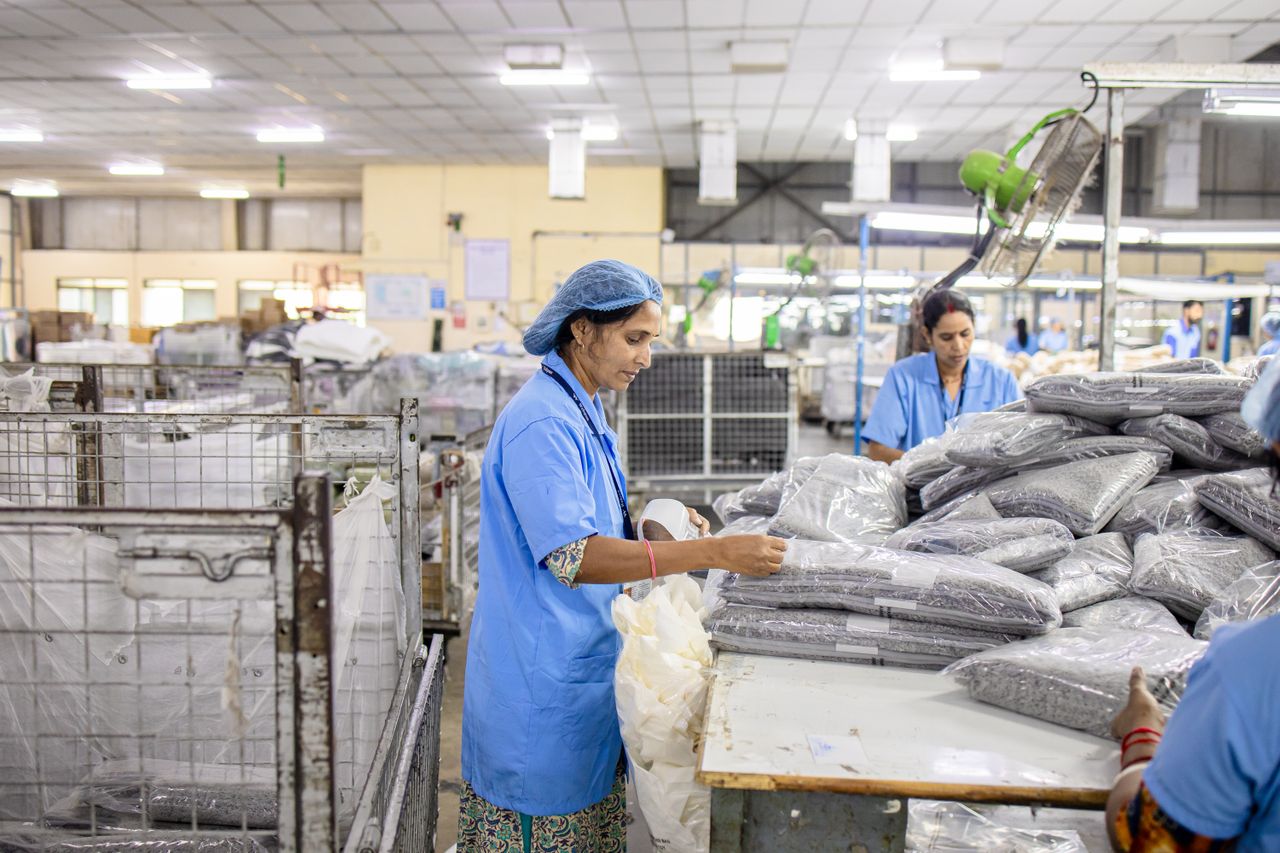
For many importers, the product that leaves a factory is already in its final retail format.
The bottle has been filled. The box has been printed. Labels have been applied. Promotional inserts have been added. Individual units have been packed into cartons, palletized, and loaded into containers.
That approach is convenient, but it is not always the most economical way to move goods across international supply chains.
Retail packaging adds volume. Market-specific packaging reduces flexibility. Final assembly can increase the amount of space a product occupies. And simple processes such as labeling, kitting, inspection, repacking, and promotional packaging may be unnecessarily expensive when performed at the source or destination.
An alternative is bulk-to-retail conversion.
Under this model, importers move cargo in a more transport-efficient bulk or semi-finished format, then complete the final transformation at an intermediate logistics hub.
For companies importing into the UAE and Europe, India offers an unusual combination of location, manufacturing capability, labor availability, packaging infrastructure, and access to international shipping routes.
Within India, Vizhinjam International Seaport in Kerala is particularly well positioned for port based value addition because it sits approximately 10 nautical miles from the main East-West international shipping route connecting the Far East, the Persian Gulf, and Europe. It operates as both a deep-water container transshipment hub and an international EXIM gateway.
This creates a simple question for importers:
Why pay to transport fully retail-ready products across the longest part of the supply chain if some of that transformation can be completed economically in India instead?
What Is Bulk-to-Retail Conversion?
Bulk-to-retail conversion means importing a product in bulk, industrial, intermediate, or minimally packaged form and converting it into its final market-ready configuration later in the supply chain.
Depending on the product, this can include:
Bottling or filling
Retail packaging
Repacking
Labeling and relabeling
Country-specific labeling
Barcode application
Kitting and bundling
Sorting and grading
Quality inspection
Product sampling
Promotional packaging
Carton preparation
Palletization
Light assembly
Addition of locally sourced components
Final export preparation
The cargo itself may already be fully manufactured. What is postponed is the final stage that makes it ready for a specific market, distributor, retailer, or customer.
This is closely related to late-stage customization, late localization, contract packaging, and manufacturing postponement.
CapeTerminal applies the model in a port logistics context by coordinating cargo transformation and port based value addition around India’s Vizhinjam International Seaport before the shipment continues to its final market.
Why Shipping the Finished Retail Product Can Cost More
The most obvious reason is space.
A product optimized for manufacturing is not necessarily optimized for international transportation.
Consider a product that can be transported tightly packed in bulk cartons, drums, intermediate containers, or component form. Once converted into individual consumer packages, it may require bottles, retail boxes, inserts, protective material, display packaging, master cartons, and pallets.
Its commercial value may increase, but so can its cubic volume.
For ocean freight, that difference matters.
If final packaging causes a shipment to occupy substantially more container space, completing that packaging at the factory means transporting the additional packaging volume across the entire long-haul route.
In some cases, the same quantity of saleable product that requires several containers in finished retail form could require fewer containers during the longest part of the journey when shipped efficiently in bulk.
The exact economics depend on the commodity, payload limits, packaging density, freight rates, handling costs, and final configuration. Dense products may reach container weight limits before volume becomes the constraint.
But where packaging creates significant volumetric expansion, bulk shipping followed by later retail packaging can change the economics of the entire shipment.
Why India Changes the Equation
Bulk-to-retail conversion only works if the intermediate location provides enough cost advantage to justify the additional handling.
India offers several advantages.
Lower-Cost Value Addition
Many activities required to prepare products for retail are labor-intensive rather than capital-intensive.
Inspection, sorting, kitting, labeling, repacking, secondary packaging, assembly, and pallet preparation can require substantial manual input.
Moving suitable processes from high-cost destination markets to India can reduce the value-addition cost per unit while preserving the ability to define exact packaging and QC standards.
The comparison should therefore not simply be:
Factory vs India.
For a UAE or European importer, the better comparison may be:
Factory vs India vs destination market.
A process that provides little saving compared with China or Vietnam may still offer a substantial advantage compared with performing the same work in Dubai, Abu Dhabi, the Netherlands, Germany, France, or another European destination.
Why Vizhinjam International Seaport Matters
India is a large country, so location within India is critical.
Moving cargo deep into the hinterland purely for packaging or light processing can eliminate part of the cost advantage through inland transportation and additional handling.
Vizhinjam offers a different proposition.
The port is positioned close to the international East-West shipping corridor. Its official port description places it approximately 10 nautical miles from the major shipping route connecting Europe, the Persian Gulf, and the Far East. It is designed as India's first deep-water container transshipment port.
The port has also developed beyond pure vessel-to-vessel transshipment. Gateway import and export operations are active, and the operator's logistics offering includes bonded warehousing and EXIM logistics capabilities.
That combination is important for port-based logistics and cargo value addition in India.
Instead of treating India as the final destination, an international importer can evaluate it as an intermediate processing location.
The supply chain becomes:
Source country → India’s Vizhinjam International Seaport → value addition → UAE or Europe
This is fundamentally different from importing products into India for Indian consumption.
The objective is to use India as a strategic value-addition point within an international supply chain.
Benefit 1: Keep the Long-Haul Shipment Compact
For suitable products, this is the strongest argument for bulk-to-retail conversion.
Suppose cargo originates in China, Vietnam, Thailand, Malaysia, or another Asian production market and is ultimately sold in the UAE or Europe.
If retail packaging substantially expands the product's volume, doing that work at origin means paying to transport the expanded product for thousands of nautical miles.
Instead, the importer can evaluate moving the cargo in a denser configuration to Vizhinjam, performing the bulk-to-retail conversion in India, and using the final retail configuration only for the shorter or remaining leg to the destination market.
The greater the packaging-related volume expansion, the more important this calculation becomes.
Benefit 2: Localize Products Later
Packaging products at the factory also forces the importer to make destination decisions early.
A manufacturer may need separate production runs for:
UAE packaging
Different European languages
Distributor-specific labels
Retailer-specific cartons
Promotional variants
Different SKU bundles
This fragments inventory.
Late-stage packaging allows the importer to postpone some of those decisions.
A common base product can move through the supply chain first. Once market demand is clearer, it can be converted into different retail configurations closer to the final destination.
This is late localization, and it can reduce both inventory complexity and forecasting risk.
For example, products intended for GCC markets can receive Arabic and English labeling, market-specific inserts, retailer packaging, or promotional bundles after the primary manufacturing process has already been completed.
For importers selling into the UAE and wider Gulf, CapeTerminal’s GCC Importer Strategy Playbook explains how India and Vizhinjam can be incorporated into a regional supply-chain model.
Benefit 3: Separate Manufacturing From Packaging
Manufacturers are usually optimized to manufacture.
They are not always the best or lowest-cost provider for every activity surrounding the product.
Importers frequently accept factory pricing for packaging, kitting, labeling, or customization simply because those services are convenient to bundle with production.
Separating manufacturing from final value addition gives the buyer more control.
The factory can focus on producing the core product. Packaging materials can be sourced independently. Final assembly can use Indian components where appropriate. Quality control can be performed independently before final export.
This creates a more modular supply chain.
For private-label brands, distributors, and large importers, that flexibility can also reduce dependence on a single supplier.
Benefit 4: Add an Independent QC Point
Moving value addition away from the source creates another useful control point.
Cargo can be inspected after leaving the manufacturer but before reaching the final customer.
Depending on the product and agreed scope, this can include checking quantities, packaging integrity, specifications, appearance, labeling, barcodes, component inclusion, or product condition.
Problems discovered at this stage can potentially be corrected before the goods reach a high-cost destination market.
For importers buying from distant suppliers, combining quality control in India with repacking, labeling, and other cargo value addition can make the intermediate stop operationally useful rather than simply adding another warehouse.
Benefit 5: Combine Imported Cargo With Indian Inputs
Bulk-to-retail conversion becomes even more interesting when packaging or components do not need to travel from the original manufacturing country.
An importer could source the core product from East Asia while sourcing cartons, bottles, labels, printed materials, inserts, simple components, or promotional materials from India where commercially and technically appropriate.
The final product is then assembled or packaged before re-export.
This creates another form of supply-chain optimization.
Instead of asking one manufacturer to supply everything, the importer can use the strengths of multiple sourcing markets.
Why the Model Is Particularly Relevant to UAE Importers
The UAE combines large import volumes with relatively high costs for many labor-intensive logistics activities.
That makes it a natural market for evaluating whether some work should happen before cargo reaches the UAE.
Products moving from Asia toward the Gulf can potentially undergo packaging, labeling, kitting, inspection, consolidation, or light assembly in India before final shipment.
The objective is not to add an unnecessary logistics stop.
It is to move an existing cost from a higher-cost point in the supply chain to a strategically located, lower-cost point.
For UAE importers, the strongest candidates are often businesses importing substantial recurring volumes, operating private labels, handling multiple SKUs, or performing repetitive packaging and preparation after arrival.
Why European Importers Should Evaluate the Same Model
For European importers, labor-cost arbitrage is only part of the opportunity.
Late localization can be equally important.
A European distributor buying one common product from Asia may serve several countries, retailers, or customer groups.
Final packaging decisions can therefore be delayed until demand becomes clearer.
India can also provide access to packaging materials, components, manufacturing services, and quality-control resources before products continue toward Europe.
The result is a supply chain in which Asia manufactures the core product, India performs selected value addition, and Europe receives a product much closer to final distribution condition.
Which Products Are Best Suited to Bulk-to-Retail Conversion?
The model is strongest when one or more of the following conditions apply:
Retail packaging causes a large increase in cubic volume.
Packaging or assembly is labor-intensive.
The importer moves meaningful recurring volumes.
Multiple destination-market variants are required.
Products require kitting or bundling.
Packaging materials can be sourced competitively in India.
Independent QC before final delivery has commercial value.
Products from multiple suppliers can be consolidated.
Final product configuration can safely be postponed.
Consumer goods, household products, hardware, automotive components, home products, promotional goods, selected industrial products, private-label products, and many non-regulated packaged goods may fit this model.
Regulated categories require additional assessment. Food, cosmetics, pharmaceuticals, chemicals, dangerous goods, medical products, and other controlled commodities may require specific licenses, approved premises, labeling procedures, testing, or customs arrangements.
The right question is therefore not whether every product should be packaged in India.
It is:
Which part of this product's supply chain becomes cheaper or more flexible if final transformation is moved to India?
What Does the Operational Workflow Look Like?
A properly managed bulk-to-retail program should be designed before the cargo leaves the source country.
The importer first defines the incoming cargo format, final retail specification, required packaging materials, quality standards, destination-market requirements, shipment schedule, and outbound configuration.
Cargo then moves to Vizhinjam and into the appropriate warehousing or processing arrangement.
Depending on the project, the next stages can include receiving, inventory verification, inspection, deconsolidation, packaging, labeling, kitting, assembly, QC, palletization, container stuffing, export documentation coordination, and outbound movement.
The value comes from coordinating these stages as one controlled workflow rather than forcing the importer to manage several disconnected vendors in another country.
CapeTerminal’s managed warehousing services are designed to coordinate storage, cargo handling, value addition, QC, and outbound preparation around Vizhinjam through a single operating layer.
When Bulk-to-Retail Conversion Does Not Make Sense
Adding another handling point is not automatically economical.
Bulk-to-retail conversion may offer little advantage when the product is already extremely space-efficient, the manufacturing facility provides packaging at very low cost, volumes are small, additional handling creates unacceptable product risk, or destination regulations prevent the proposed processing model.
The same applies when the additional logistics, customs, packaging, storage, and handling costs exceed the savings created elsewhere.
This is why importers should evaluate the total landed cost, not simply compare hourly labor or packaging prices.
Calculate the Supply Chain, Not Just the Packaging Cost
A proper analysis should include:
Inbound ocean freight
Number and type of containers required
Origin packing cost
Cargo handling
Warehousing
Packaging materials
Labor
Inspection and QC
Customs-related costs
Inland movement
Outbound ocean freight
Destination handling
Inventory carrying cost
Potential reduction in destination-side processing
Container utilization before and after conversion
The largest opportunity may not come from cheaper packaging alone.
It may come from transporting fewer containers on the longest route, reducing expensive destination labor, combining multiple operations in India, or avoiding premature SKU fragmentation.
Use CapeTerminal’s Cargo Savings Estimator to evaluate whether shifting cargo processing to Vizhinjam could reduce the total cost of a specific shipment.
Port Based Value Addition Is a Supply-Chain Design Decision
The broader opportunity goes beyond packaging.
Port based value addition treats the port region not simply as a place where containers are transferred, but as a strategic point where cargo can become more valuable, more market-ready, or more efficient before continuing to its destination.
Bulk-to-retail conversion is one of the clearest examples.
The same principle can apply to inspection, sorting, grading, labeling, kitting, consolidation, assembly, component addition, repacking, palletization, and other forms of cargo transformation.
Vizhinjam's location on India's southern coast makes this especially relevant.
When cargo already moves along the East-West trade corridor, the question for global importers is no longer simply where was the product manufactured?
A better question is:
Where should each stage of the product be completed to achieve the lowest cost, highest flexibility, and best control?
For some supply chains, the answer to the final stages may be India.
Rethink Where the Finished Product Is Created
Global sourcing does not require every stage of a product to happen in the country where it was manufactured.
A factory can produce the product.
India can transform it.
The destination market can receive it ready for sale.
For importers in the UAE and Europe, bulk-to-retail conversion in India creates an opportunity to rethink container utilization, packaging costs, destination labor, inventory flexibility, quality control, and sourcing as parts of one supply-chain equation.
Vizhinjam International Seaport gives that model a strategic maritime location.
CapeTerminal's role is to make the intermediate stage manageable by coordinating the facilities, warehousing, service providers, cargo transformation, QC, documentation, and outbound logistics required to move cargo from arrival to market-ready re-export.
For the right products and shipment volumes, shipping in bulk and packaging later is not simply a packaging decision.
It is a different way to design the supply chain.
Frequently Asked Questions
What is bulk-to-retail conversion?
Bulk-to-retail conversion is the process of transporting a product in bulk, intermediate, or minimally packaged form and completing retail packaging, labeling, kitting, assembly, or other final preparation later in the supply chain.
Why perform bulk-to-retail conversion in India?
India can offer competitive labor, packaging, manufacturing, sourcing, and logistics capabilities. For cargo moving between Asian production centers and markets such as the UAE or Europe, India can also function as an intermediate value-addition location rather than the final destination.
What is port based value addition?
Port based value addition means performing activities that increase a cargo's commercial readiness or value at or around a port logistics hub. Examples include packaging, labeling, QC, sorting, kitting, consolidation, assembly, repacking, and export preparation.
Why is Vizhinjam International Seaport suitable for cargo value addition?
Vizhinjam International Seaport is located on India's southern coast approximately 10 nautical miles from the main East-West international shipping route. It combines deep-water transshipment operations with gateway EXIM capability, giving importers a strategically positioned Indian entry and re-export point.
Can UAE importers use India for packaging before final delivery?
Potentially, yes. A UAE importer can evaluate whether suitable cargo can move from its manufacturing origin to India for packaging, labeling, inspection, consolidation, or other value addition before onward shipment. The feasibility depends on the commodity, customs structure, regulatory requirements, shipment volumes, and total landed-cost calculation.
Is packaging in India always cheaper?
No. The decision should be based on the complete supply-chain cost. India is most attractive when savings in labor, packaging, container utilization, localization, sourcing, inventory, or destination processing exceed the additional handling and logistics required.
What can CapeTerminal manage around Vizhinjam?
CapeTerminal coordinates managed warehousing, cargo value addition, inspection and quality control, sorting, repacking, labeling, kitting, consolidation, assembly, export preparation, and related shipment workflows through facilities and service providers around Vizhinjam.