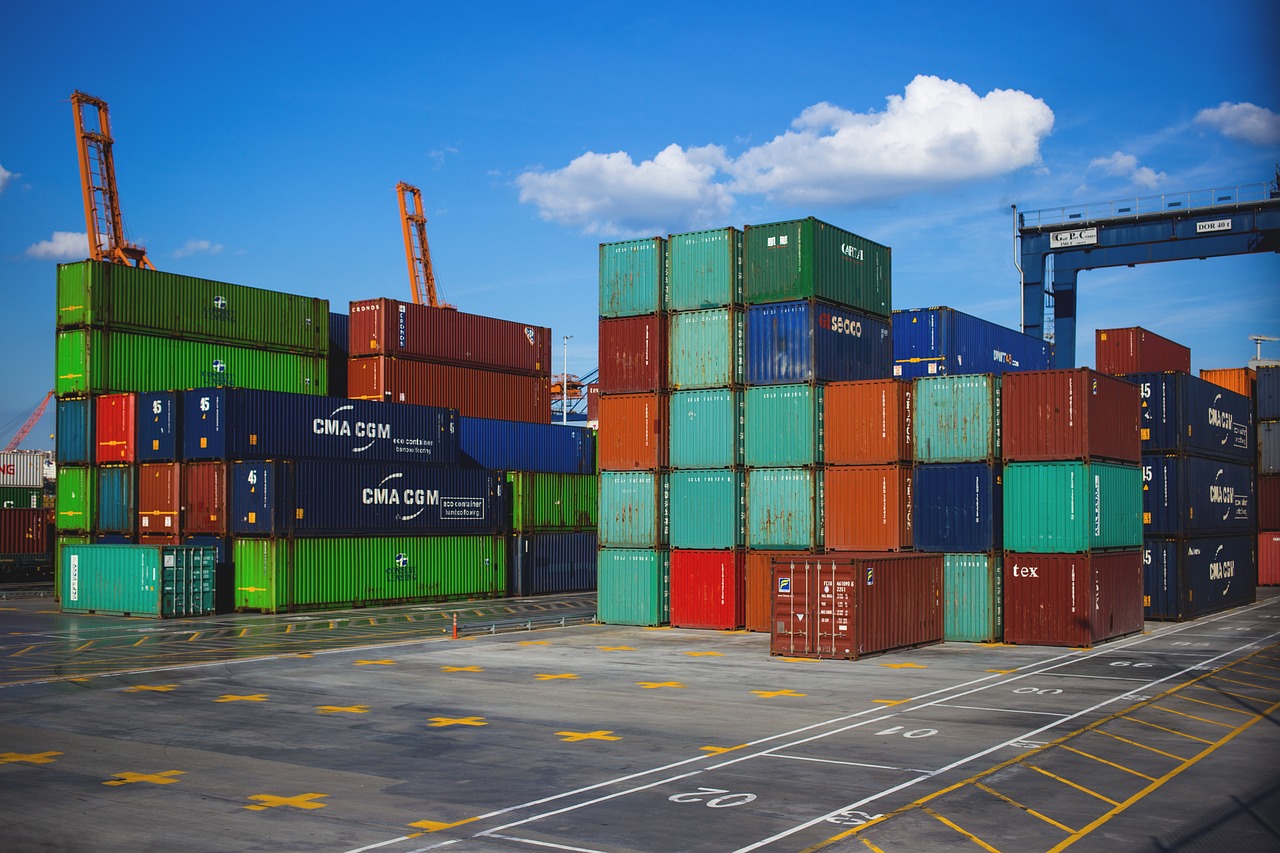
For a UAE importer buying from China, the traditional supply chain is straightforward.
Manufacture the product in China. Complete the packaging, labeling and assembly at the factory. Load the finished goods into containers. Ship them to the UAE. Store and distribute them from Dubai.
It works, but it also assumes that China should perform almost every activity before the cargo leaves the country.
There is another model worth evaluating:
China → Vizhinjam, India → UAE
Under this approach, the Chinese supplier focuses on what it does best. Selected final-stage activities such as packaging, kitting, labeling, assembly, quality control or consolidation are moved to India. The cargo is then re-exported toward Dubai or another UAE gateway in its finished form.
India’s Vizhinjam International Seaport, located on the country's southern tip, makes this model particularly interesting. The port sits about 10 nautical miles from the international east-west shipping route linking the Far East, Persian Gulf and Europe. It is India’s first deep-water container transshipment port and was designed specifically around large mainline container movements.
For UAE importers, the opportunity is not simply "cheap processing in India." It is the ability to redesign where different parts of the supply chain happen.
The conventional China-to-Dubai import model
China remains one of the world's most competitive manufacturing bases. For many products, there is little reason to move the core manufacturing process elsewhere.
The problem is that manufacturing and final product preparation are not the same thing.
A factory may manufacture an appliance, household product, hardware item or consumer accessory very efficiently. The UAE importer may then ask the same supplier to:
source retail cartons
print Arabic and English packaging
procure inserts or accessories
assemble retail kits
apply market-specific labels
carry out additional quality checks
bundle products for particular distributors
pack everything into its final retail configuration
The factory can usually arrange these tasks. That does not necessarily mean it is the cheapest or most flexible place to perform them.
Third-party packaging materials may carry procurement markups. Manual finishing operations may not benefit from the same economics as automated manufacturing. Retail packaging may also make each unit considerably larger before the longest part of its ocean journey has even begun.
A UAE importer therefore needs to separate two questions:
Where should the product be manufactured?
And:
Where should the product become UAE-ready?
Those answers do not always have to be the same country.
Vizhinjam creates a third stage between China and the UAE
Vizhinjam International Seaport gives importers another location to consider between factory and final market.
The concept is port based value addition.
Instead of sending cargo to the UAE in completely finished retail form, suitable products can move toward India in bulk, semi-finished or common configuration. Selected processing takes place around Vizhinjam before the cargo continues to the UAE.
A simplified supply chain could look like this:
Chinese manufacturer → ocean shipment to southern India → cargo value addition near Vizhinjam → re-export to UAE → local distribution
The activities performed in India depend on the product. They could include packaging, repacking, labeling, kitting, sorting, assembly, inspection, palletization or consolidation with Indian-sourced goods.
Vizhinjam's relevance comes from its maritime position. It is not an inland manufacturing location that requires cargo to travel far away from major shipping lanes. The port was developed as an international transshipment gateway directly alongside the east-west maritime corridor.
Its scale is also increasing quickly. Vizhinjam handled 1.3 million TEUs during FY26 and crossed 2 million cumulative TEUs within 18 months of operations. In June 2026, MSC Group's terminal investment arm agreed to acquire a 49 percent interest in the port concessionaire, subject to customary approvals.
For an importer, those developments matter because a port-based processing model becomes more practical as connectivity, cargo frequency and surrounding logistics infrastructure expand.
Where can the savings come from?
Move manual value addition away from Dubai
Dubai is an excellent logistics and distribution center, but it is not always the cheapest place to perform repetitive manual processing.
If thousands of units must be labeled, kitted, repacked, inspected or assembled, a small difference in cost per unit can become significant.
Suppose a container holds 30,000 units and India reduces the total processing cost by just $0.08 per unit.
That represents $2,400 of potential savings on one container before considering any other advantage.
At 50,000 units, the same eight-cent difference becomes $4,000.
The relevant calculation is not simply Indian labor cost versus UAE labor cost. Additional handling, storage, customs procedures, inland movement and onward freight must also be included.
That full-cost calculation is what determines whether the model works.
Reduce dependence on factory-sourced packaging
One of the more overlooked opportunities is supplier procurement markup.
A Chinese OEM may manufacture the core product competitively while sourcing cartons, bottles, inserts, printed materials or accessories from other vendors on the importer's behalf.
Convenience comes at a price.
The importer may be paying the supplier's purchasing margin in addition to the underlying packaging cost. Moving selected final packaging to India can give the importer greater visibility into those individual costs.
The model could become:
Manufacture the product in China → source packaging or accessories in India → combine them near Vizhinjam → export the finished retail product to Dubai
India has a large packaging, printing, plastics, textile, engineering and light-manufacturing base. For the right SKU, sourcing one or more inputs in India can create a larger saving than labor arbitrage alone.
This is the India sourcing arbitrage combined with port based value addition.
Ship the product, not unnecessary packaging volume
Finished retail products can consume much more container space than their underlying contents.
Retail cartons, bottles, protective inserts, display packaging and bundled accessories may increase cubic volume substantially.
If those materials are added at the Chinese factory, the importer transports that extra volume from China across the entire shipping leg.
For suitable products, the alternative is bulk-to-retail conversion.
Cargo leaves China in a dense transport configuration. Retail packaging is introduced in India. Finished units then travel the shorter onward leg toward the UAE.
This can be particularly valuable when packaging causes a large increase in cubic volume.
The opportunity is not limited to the price of the box or bottle. The importer may also be able to improve container utilization on the long-haul leg.
That can change how many containers are required for the same number of saleable units.
Use India for Arabic labeling and UAE market preparation
UAE-bound products often require market-specific packaging, labels, instructions, barcodes or distributor information.
Completing every detail in China forces those specifications to be finalized early.
An importer can instead maintain a common product configuration for longer and carry out selected UAE localization closer to the final market.
That could include Arabic and English labels, retail cartons, inserts, promotional bundles or distributor-specific packaging.
This is a form of late localization.
The importer delays the point at which a generic product becomes committed to one specific market.
For companies selling across the UAE, Saudi Arabia, Qatar, Oman, Kuwait and Bahrain, the same principle can be extended further. Common inventory can potentially be divided into separate GCC market configurations later in the supply chain.
Add independent quality control before the cargo reaches Dubai
Quality problems become expensive when they are discovered after import.
By the time defective or incorrectly packed cargo reaches a UAE warehouse, ocean freight has already been paid, local import procedures have taken place, and delivery commitments may be approaching.
A Vizhinjam processing stage can also create an intermediate QC checkpoint.
Depending on the product, cargo can be opened, sampled, inspected, counted, sorted or checked against packaging and product specifications before final re-export.
This does not replace factory quality assurance.
It creates another control point between the supplier and the UAE market.
For private-label importers in particular, this can be useful when the importer wants a party independent of the Chinese factory to verify finished output.
Consolidate Chinese cargo with products sourced from India
The China → Vizhinjam → Dubai model becomes even more interesting when the importer already buys goods from India.
Consider a UAE company purchasing:
the main product from China
printed packaging from India
accessories from India
textile components from India
The conventional approach may send those shipments independently to Dubai, where they are stored, combined and prepared for distribution.
An alternative is to consolidate them in India.
The Chinese cargo arrives near Vizhinjam. Indian materials are brought into the same supply chain. The final kit or retail product is created before onward shipment to the UAE.
Instead of treating India as a detour, it becomes the convergence point for a multi-country supply chain.
This can reduce supplier fragmentation and move final product preparation away from higher-cost destination operations.
Managed warehousing adds another layer of flexibility
Not every shipment needs to enter and leave India immediately.
For suitable cargo, managed warehousing around Vizhinjam can create an inventory buffer between Asian manufacturing and GCC demand.
A UAE importer could hold common inventory in India and release cargo according to demand rather than committing every unit to final market configuration months in advance.
Managed warehousing can support:
delayed packaging
phased re-export
multi-supplier consolidation
quality inspection
inventory sorting
packaging-material storage
market-specific configuration
short-term buffering before onward shipping
This changes the role of the warehouse.
It is no longer simply somewhere to store containers or cartons. It becomes an operating point where the importer can control how inventory is transformed and released.
What products are most suitable?
The model is strongest when the product contains a meaningful amount of finishing work that is separate from core manufacturing.
Consumer goods with high unit counts are particularly interesting because small per-unit savings multiply quickly.
Potential candidates include household products, cleaning products, personal-care items where regulations permit, hardware, electrical accessories, home goods, textiles, promotional merchandise, private-label products and products sold as multi-item kits.
The strongest candidates often share several characteristics.
They have high unit counts. Packaging or assembly contains manual work. Retail packaging adds significant volume. The supplier charges extra for packaging procurement. Different markets require different configurations. Indian components can replace or complement Chinese inputs.
A product does not need to meet every condition.
Even two or three may justify running the numbers.
When China should still complete the work
Port based value addition should not be treated as a universal replacement for factory-side processing.
China can be extremely efficient at highly automated packaging and assembly. If a factory produces enormous volumes on dedicated machinery, recreating that operation in India may make no economic sense.
The model is also less attractive when the value-added activity is tightly integrated into manufacturing, when shipment quantities are small, or when additional handling creates significant product risk.
Some regulated products may also require specific licensing, customs procedures or processing environments that determine where work can take place.
The objective is not to move work from China for the sake of moving it.
It is to identify the parts of the supply chain where China has the advantage, the parts where India has the advantage, and the activities that genuinely need to remain in the UAE.
Vizhinjam does not replace Dubai
Dubai remains the destination, commercial center and distribution platform for many UAE importers.
The Vizhinjam model is not about replacing that role.
It is about avoiding the use of expensive destination infrastructure for work that could have been completed more economically before the cargo arrived.
The ideal division might be:
China for manufacturing.
India for selected value addition, sourcing, consolidation and QC.
Dubai for inventory close to customers, distribution and sales.
That separation can produce a more efficient supply chain than forcing either China or Dubai to perform everything.
A new way to think about China-to-UAE imports
China-to-Dubai shipping is usually discussed in terms of freight rates, transit times, container sizes and customs clearance.
Those factors matter, but they represent only part of landed cost.
Importers should also ask where packaging is purchased, where labor-intensive work takes place, how much container space finished packaging consumes, when inventory becomes committed to a specific market, and where product quality is checked.
India’s Vizhinjam International Seaport creates a new location at which those decisions can be made.
The model will not work for every container.
For the right cargo, however, a shipment does not have to leave China completely finished and it does not have to reach Dubai before value can be added.
It can be manufactured in China, transformed in India and sold in the UAE.
That is the larger opportunity behind port based value addition at Vizhinjam.
Frequently Asked Questions
What is the China → Vizhinjam → Dubai supply-chain model?
It is a supply-chain structure in which goods manufactured in China are routed through India for selected packaging, labeling, assembly, quality control, consolidation or other value addition before being re-exported to the UAE. Vizhinjam International Seaport provides a strategically located maritime gateway in southern India for evaluating this model.
What is port based value addition?
Port based value addition is the performance of cargo transformation activities at or near a port during an international shipment. These activities can include packaging, repacking, labeling, kitting, assembly, QC, sorting, consolidation and other processes that increase the commercial readiness or value of cargo before it reaches its final market.
Why use Vizhinjam for China-to-UAE cargo?
Vizhinjam International Seaport is located roughly 10 nautical miles from the major east-west shipping route connecting the Far East, Persian Gulf and Europe. Its deep-water transshipment role and growing mainline connectivity make southern India relevant as an intermediate processing location for cargo moving between Asia and markets to the west.
Can goods manufactured in China be packaged in India and exported to Dubai?
Potentially, yes. The feasibility depends on the product, customs structure, applicable regulations, processing requirements and shipment economics. Importers should evaluate the complete cost of landing, handling, processing and re-exporting the cargo rather than looking at processing cost in isolation.
Can UAE importers source packaging materials from India?
Yes, where suitable suppliers and specifications are available. An importer may be able to source cartons, printed materials, plastic components, labels, textiles, accessories or other inputs from India and combine them with imported Chinese goods before onward export.
Is processing cargo in India always cheaper than China?
No. China can be exceptionally competitive in automated manufacturing and high-volume processing. India is more compelling when the activity involves manual work, supplier procurement markups, Indian-sourced inputs, bulky retail packaging, late localization, consolidation or other advantages beyond labor cost alone.
How can an importer determine whether the model is viable?
Start with the unit count, container utilization, current factory-side processing cost, packaging cost, destination processing cost and any potential Indian sourcing savings. Then add the costs associated with handling, storage, processing and onward transportation through India. The model is attractive only when the total supply-chain saving exceeds the additional cost and complexity.