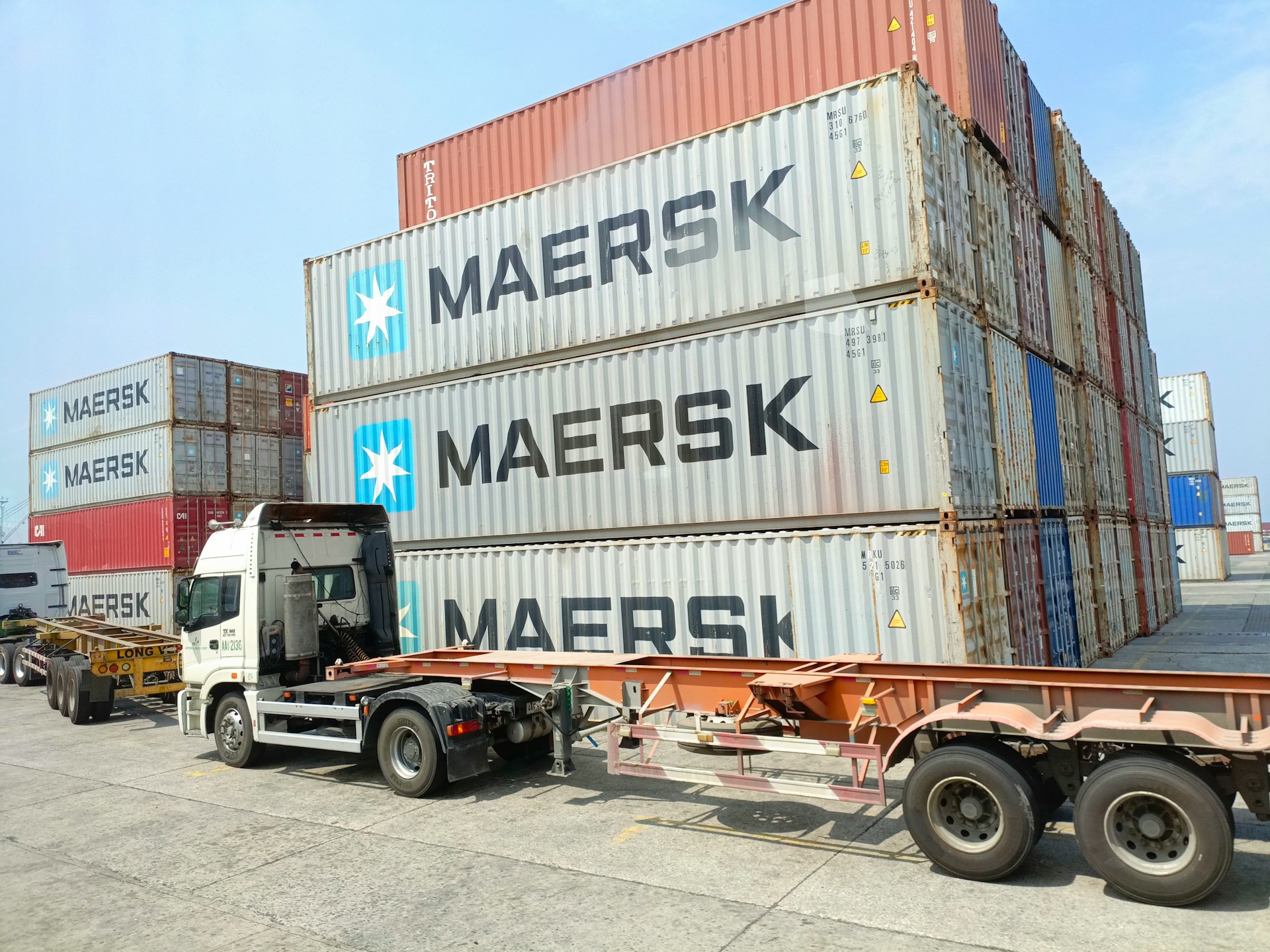
Vizhinjam International Seaport is moving beyond transshipment and developing its gateway import-export cargo business. Every container entering or leaving the port for a warehouse, factory, container freight station or customer must be moved by road or rail.
This creates an opportunity for container trucking companies, individual truck owners, fleet operators and transport coordinators serving Vizhinjam.
VISL is targeting an increase in annual EXIM cargo from approximately 0.15 million TEUs to 1.5 million TEUs by 2028. At 1.5 million TEUs a year, average gateway movement would exceed 4,100 TEUs a day before accounting for seasonal peaks. A 40-foot container equals two TEUs, so TEU volume should not be confused with the number of truck trips. The eventual road demand will depend on the mix of 20-foot and 40-foot containers, rail usage, empty-container movements and the distance of inland destinations.
What does a Vizhinjam container trucking business do?
Container trucking between a port and a nearby logistics facility is commonly called container drayage.
A Vizhinjam container transporter may handle movements between:
Vizhinjam port and a container freight station
The port and an importer’s warehouse
The port and a customs-bonded warehouse
The port and a MOOWR manufacturing unit
A CFS and the final customer
A factory and the port for export
A warehouse and a value-addition facility
Empty-container depots and exporters
Reefer yards and cold-storage facilities
Industrial clusters in Kerala and Tamil Nadu
Some trips may cover only 10 or 20 kilometres. Others may carry containers to Kollam, Nagercoil, Tirunelveli, Gangaikondan, Nanguneri, Tuticorin, Madurai or Coimbatore.
The business model, truck specification and pricing must match the route.
How much does it cost to start?
A new operator should budget for the complete tractor-trailer combination, not only the tractor head.
Indicative investment for one new vehicle is:
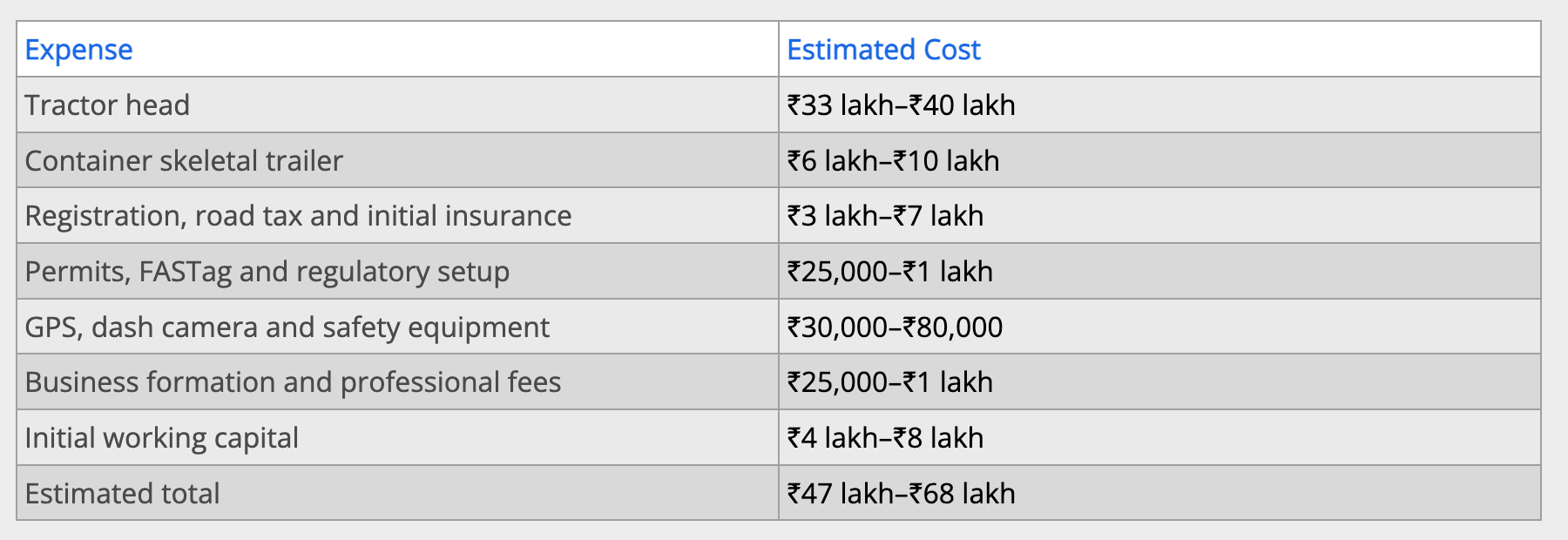
Actual prices depend on the vehicle, trailer design, state registration charges, insurance, financing and dealer discounts.
Ashok Leyland currently lists 4×2 tractor combinations with three-axle trailers from approximately ₹33.50 lakh and 6×4 combinations from ₹43.50 lakh. Tata Motors lists a Signa 5530.S tractor at an indicative ex-showroom price of approximately ₹36.38 lakh, with some tractor-trailer packages listed above ₹40 lakh. OEM package trailers may not be the skeletal container trailer required for a specific operation, so the body configuration must be confirmed before purchase.
A used tractor-trailer can reduce the initial investment, but older vehicles may bring higher maintenance costs, tyre failures, financing difficulties and restrictions from large customers. Engine, gearbox, chassis, fifth wheel, suspension, brakes, tyres and trailer twist locks should be independently inspected before purchase.
Choosing the right container truck
A container truck has two primary components:
The tractor head
The skeletal semi-trailer carrying the container
Many of the current models of higher end trucks today could be modified to transport containers by attaching a skeletal semi-trailer with twist lock mechanisms to secure the container in place.
Container truck models available in India
Suitable models should be compared based on torque, service support, fuel efficiency, driver comfort, braking systems and actual operating weight.
Tata Signa 5530.S 4×2
The Tata Signa 5530.S is a 55-tonne gross-combination-weight tractor with a 300 HP engine and approximately 1,100 Nm of torque. It is suited to heavy highway haulage and is widely supported through Tata’s commercial-vehicle network.
Tata Prima 5530.S
The Prima 5530.S uses a 300 HP Cummins engine and is positioned as a premium heavy-duty tractor. Features such as hill-start assistance, engine braking and a better-equipped cabin can be valuable on long routes and for driver retention.
Ashok Leyland AVTR tractors
Ashok Leyland offers 4×2 and 6×4 tractor configurations with two-axle and three-axle trailer options. Its service network and familiarity among South Indian fleet operators make it a practical option for Vizhinjam-linked work.
BharatBenz 5528T 4×2
The BharatBenz 5528T has a 55-tonne configuration, a 7.2-litre engine, approximately 281 HP and 1,100 Nm of torque. It meets BS-VI OBD-2 emission standards.
A dealer quotation should include expected fuel efficiency, warranty, service intervals, annual maintenance packages, tyre specification and nearby authorised workshops.
Choosing the container trailer
The trailer determines which containers the vehicle can legally and safely carry.
40-foot skeletal trailer
This is commonly used for:
40-foot standard containers
40-foot high-cube containers
Some 20-foot containers when the trailer is designed with suitable locking positions
The placement of a single heavy 20-foot container matters. Incorrect positioning can overload an axle even when the vehicle’s total weight appears legal.
Dedicated 20-foot trailer
A shorter trailer may be suitable for local movement of loaded 20-foot containers. It can be easier to manoeuvre but cannot carry a 40-foot container.
20/40-foot convertible trailer
A convertible or telescopic skeletal trailer provides greater flexibility. It is useful for operators who do not yet know the expected mix of container sizes.
Twin 20-foot trailer
Some trailers can carry two 20-foot containers. The operator must confirm:
Approved trailer configuration
Twist-lock positions
Legal axle-load distribution
Combined container weight
Terminal and customer acceptance
Two heavy 20-foot containers can exceed legal road limits even when each container is within its own maximum gross mass.
Reefer-container trailer
A normal skeletal trailer can carry a refrigerated container, but longer journeys may require a clip-on generator set or another power arrangement. The customer may also require temperature records and monitoring during transit.
Never purchase a trailer without confirming its registration, approved dimensions, axle rating, braking system, tyre specification and twist-lock certification.
Registrations and permits required
The exact requirements depend on the business structure, vehicle registration state, operating routes and cargo type.
Business registration
A single-truck owner may begin as a proprietorship. Larger fleets may prefer an LLP or private limited company.
The business should have:
PAN
Business bank account
Address proof
Udyam registration, where useful
GST registration or transporter enrolment, as applicable
Accounting and invoicing system
Written transport terms and liability conditions
GST and transporter identification
An unregistered transporter can enrol on the e-way bill portal and receive a 15-digit Transporter ID, known as a TRANSIN. A GST-registered transporter normally uses its GSTIN.
The Transporter ID allows clients to assign e-way bills to the transporter, who can then enter or update the vehicle details.
The tax treatment of Goods Transport Agency services depends partly on whether the transporter issues a consignment note and the GST option used. This should be structured with a chartered accountant before issuing invoices.
Commercial vehicle registration
The tractor and trailer must be properly registered for their approved use. The registered gross combination weight and axle configuration must match the actual combination.
Goods carriage permit
A transport vehicle must operate under the appropriate goods carriage permit.
A state permit may be sufficient for operations entirely within Kerala. A national permit or relevant interstate authorisation will be required when the vehicle regularly crosses into Tamil Nadu or other states. Permit applications and national-permit authorisation are administered through the transport authorities and VAHAN system.
Vehicle documents
The truck should have current:
Registration certificate
Goods carriage permit
Fitness certificate
Commercial motor insurance
Pollution Under Control certificate
Road-tax records
FASTag
Driver’s licence for the applicable vehicle class
Trailer registration and related documents
Parivahan identifies registration, insurance, fitness, permit, driving licence and PUC among the principal documents checked for a commercial vehicle.
Cargo and liability insurance
Motor insurance does not automatically cover the value of the goods being carried.
Depending on the contract, the operator may need:
Carrier’s legal liability insurance
Goods-in-transit cover
Employee or driver accident cover
Public liability cover
Special cover for hazardous or high-value cargo
The contract must state who is responsible for cargo insurance, seal integrity, delays, theft and container damage.
Port entry permits at Vizhinjam
Owning a registered commercial truck does not give the vehicle unrestricted access to the container terminal.
The truck will normally need an active container movement or authorised job connected to a shipping line, customs broker, CFS, importer, exporter or terminal customer.
The operating process may include:
Registration or onboarding of the transport company
Submission of tractor and trailer documents
Driver identification and gate-pass approval
Terminal job order or vehicle appointment
Container number and booking details
Customs or shipping-line release
Safety inspection
RFID, access card or terminal-system registration
Compliance with PPE and traffic rules
The official Vizhinjam port page currently provides customer registration, visitor-pass access, container tracking and a container communication matrix. The exact truck-gate procedure can change as gateway operations develop, so operators should obtain the latest AVPPL trade circulars and gate instructions before accepting work.
Drivers should be prepared to carry:
Valid driving licence
Government photo identification
Port gate pass or temporary authorisation
Vehicle and trailer documents
Container job order
Shipping-line or CFS instructions
Customs documents where applicable
High-visibility jacket, safety shoes and other prescribed PPE
A cleaner, helper or unauthorised passenger may not be allowed into a controlled terminal area.
How an import container movement works
Import cargo does not simply leave the port because a transporter has arrived.
A typical import process may involve:
The vessel discharges the container.
The shipping line issues or approves delivery release.
The importer or customs broker completes the required customs process.
The terminal or CFS movement is authorised.
A truck and trailer are assigned.
The driver enters the terminal using the approved job order.
The container is mounted and an equipment interchange record is generated.
The truck exits after gate and document verification.
The container is delivered to the nominated CFS, bonded warehouse or customer.
The empty container is returned to the depot nominated by the shipping line.
The names of terminal documents vary between operators, but may include:
Delivery order
Bill of Entry
Out-of-charge status
Terminal job order
Gate pass
Equipment interchange receipt
Customs movement permission
Container release
E-way bill, where applicable
The driver must never deliver a container to a location different from the nominated destination merely because the customer requests it by phone.
Direct Port Delivery and CFS movement
Direct Port Delivery
Under Direct Port Delivery, an eligible import container can move from the terminal directly to the importer or nominated facility after customs and terminal requirements are completed.
This can reduce:
CFS handling
Additional lifting
Storage
Dwell time
Intermediate transport
A DPD trip requires tight coordination because the importer must be ready to receive and unload the container.
Movement to a CFS
A container may instead move under customs control from the port to a Container Freight Station.
The CFS may handle:
Customs examination
De-stuffing
Cargo storage
Consolidation
Delivery after clearance
Export stuffing
Container handling
For a truck operator, port-to-CFS movement and CFS-to-customer movement are separate operational legs. Each can involve different documents, gate queues and payment parties.
Non-obvious CFS issues
The CFS is a controlled customs area
A driver cannot open the container, alter the seal or change the destination without authorisation.
Waiting time can destroy the trip margin
A short trip may still occupy the truck for most of the day because of:
Terminal queues
CFS queues
Customs examination
Missing documents
Crane or reach-stacker delays
Customer unloading delays
Empty-depot congestion
Quotes should include free waiting time and detention charges after that period.
The empty return location matters
The shipping line may nominate an empty-container depot far from the delivery location. A profitable loaded trip can become unprofitable when the empty return is ignored.
Before quoting, confirm:
Empty depot
Return deadline
Container condition requirements
Depot operating hours
Lift-off charges
Whether another export load can reuse the container
CapeTerminal Managed Platform helps reduce empty return trips with our automated GPS tracking software.
Equipment condition must be recorded
At each interchange, the driver should photograph:
All container sides
Roof where visible
Doors
Seal
Corner castings
Trailer contact points
Existing dents or holes
The Equipment Interchange Receipt should record pre-existing damage. Otherwise, the transport company may later be charged for damage it did not cause.
Export-container operations
An export container may follow one of two main routes.
Factory-stuffed or warehouse-stuffed container
The empty container is collected from a depot and taken to the exporter or approved facility.
After stuffing:
The container is sealed.
Export and customs documentation is completed.
Verified Gross Mass is declared.
The loaded container is taken to the terminal.
It must arrive before the shipping-line and terminal cut-off.
CFS-stuffed container
Loose cargo is carried to a CFS, where it is examined, consolidated and loaded into a container.
The container is then moved from the CFS to the terminal.
Export delays can be expensive because a missed gate cut-off may cause the container to miss the vessel. Contracts should state who pays for additional storage, detention and rebooking when the delay is not caused by the transporter.
E-way bill rules for container transport
An e-way bill is generally required when goods valued above ₹50,000 are transported, unless a specific exemption applies. The consignor, consignee or transporter may generate it, depending on the transaction. The person in charge of the vehicle should carry the relevant invoice, bill of supply, delivery challan or Bill of Entry and the e-way bill where required.
For road transport, Part B should contain the number of the vehicle actually carrying the goods.
If the tractor is replaced after a breakdown, the new vehicle number must be updated before movement continues.
For normal cargo, e-way bill validity is generally calculated at one day for every 200 kilometres or part thereof. Different validity applies to over-dimensional cargo.
When an e-way bill may not be required
Rule 138 includes exemptions for certain customs movements, including:
Goods moving from a customs port to an ICD or CFS for customs clearance
Goods transported under customs supervision or customs seal
Specified movements under customs bond
Movement of empty cargo containers
These exemptions do not mean that the truck can move without documents. The driver should still carry the customs movement documents, Bill of Entry, delivery instructions and container records applicable to that trip.
After customs clearance, ordinary movement to the importer may require an e-way bill if the threshold and other conditions are met.
The customs broker or cargo owner should confirm the correct document set for each movement. The transporter should not decide applicability based only on whether the container is sealed.
Transporting cargo to a MOOWR warehouse
MOOWR refers to the Manufacture and Other Operations in Warehouse framework under the Customs Act.
A MOOWR facility is a private bonded warehouse authorised to carry out approved manufacturing or other operations on warehoused goods.
The scheme can be relevant to Vizhinjam because imported cargo may move from the port to a bonded facility for packaging, labelling, assembly, processing or other port based value addition before domestic clearance or re-export.
Does a trucking company need a MOOWR licence?
No. MOOWR licensing applies to the warehouse and its operator, not to the ordinary transport company carrying the sealed container.
The trucker must, however, follow the customs-controlled transport instructions.
Documents for port-to-MOOWR movement
For movement from a customs station to a Section 65 unit, the goods are normally accompanied by the warehousing Bill of Entry.
That does not make it an ordinary commercial delivery.
The transporter should:
Verify the container and seal numbers
Match the destination with the warehousing documents
Preserve the customs or electronic seal
Travel directly to the authorised premises
Avoid unauthorised unloading or transshipment
Obtain proof of receipt from the warehouse
Report accidents, seal damage or route interruptions immediately
Goods transferred between warehouses can require the forms prescribed under the relevant warehousing regulations.
Can the container stop at another factory?
A transporter should not take bonded goods to an unapproved third-party processing facility merely because the MOOWR warehouse operator requests it.
The permitted location, goods, operation and movement must match the customs authorisation. Any movement outside the bonded premises must be legally structured by the warehouse operator and customs professionals.
Weight and axle-load compliance
The maximum gross mass printed on a container does not establish how much can legally be carried on an Indian road vehicle.
The operator must consider:
Tractor kerb weight
Trailer weight
Container tare weight
Cargo weight
Registered gross combination weight
Axle-wise load distribution
Trailer configuration
Road and bridge restrictions
A heavy 20-foot container can create a concentrated load over the trailer axles. It may be more difficult to carry legally than a longer container with a better-distributed load.
The transporter should obtain:
Verified Gross Mass
Container tare weight
Cargo declaration
Weighbridge record where required
Overloading increases tyre, brake, suspension and accident risk. It can also invalidate commercial assumptions and expose the operator to enforcement action.
Hazardous and specialised cargo
Standard registration is not enough for every commodity.
Additional requirements may apply to:
Petroleum and flammable goods
Chemicals
Hazardous waste
Gas cylinders
Explosives
Pharmaceuticals
Food cargo
Refrigerated goods
Over-dimensional cargo
The vehicle, driver training, emergency equipment, placarding, insurance and route may all need to meet commodity-specific rules.
A new operator should avoid hazardous cargo until the business has the required vehicle, insurance, trained driver and emergency procedures.
How container trucking rates are calculated
A quotation should account for more than kilometres.
The rate may include:
Base trip charge
Distance
Container size
Cargo weight
Fuel cost
Tolls
Port or CFS waiting
Driver allowance
Night operations
Empty-container return
Lift-on and lift-off charges
Detention
Multi-point delivery
Hazardous or reefer requirements
Interstate permits and taxes
A low per-kilometre quote can lose money when the truck waits eight hours at a terminal.
For short-distance drayage, pricing per trip with a defined waiting allowance is often more suitable than pricing only per kilometre.
Best business models for a new operator
One truck under a dedicated contract
This is the safest entry when a freight forwarder, importer, CFS or warehouse provides minimum monthly work.
The contract should define:
Minimum trips
Route
Payment period
Fuel escalation
Waiting charges
Empty returns
Breakdown replacement
Cargo liability
Spot-market operation
Spot work offers flexibility but produces uncertain utilisation. A new financed truck should not depend entirely on daily phone calls for loads.
Fleet aggregation
A transport coordinator can build a network of independent tractor-trailer owners and allocate work without owning every vehicle.
The coordinator needs strong dispatch, documentation, tracking and payment systems.
CFS or warehouse shuttle
A vehicle can be contracted for repeated movement between the port and a specific facility. The route may be short, but profitability depends on the number of completed cycles each day.
Specialised reefer or bonded-cargo transport
This can produce better rates but requires stronger compliance, monitoring and operational discipline.
Mistakes that can make container trucking unprofitable
The most common errors are:
Purchasing the truck before securing customers
Ignoring the cost of the skeletal trailer
Assuming one TEU equals one truck
Quoting without checking cargo weight
Failing to price waiting time
Ignoring empty-container return distance
Allowing e-way bills to carry the wrong vehicle number
Accepting containers without recording existing damage
Missing vessel or terminal cut-offs
Depending on one driver without a replacement plan
Accepting 60- or 90-day payments without working capital
Carrying bonded cargo to an unauthorised location
Buying a 6×4 when the route does not justify it
Operating without written cargo-liability terms
How to get container trucking work at Vizhinjam
Potential customers include:
Freight forwarders
Customs brokers
Shipping agents
Importers and exporters
Container freight stations
Bonded warehouses
MOOWR facilities
Packaging and value-addition companies
Manufacturers
Cold-storage operators
Third-party logistics companies
Empty-container depots
A transporter should be ready to provide:
Tractor and trailer details
20-foot and 40-foot capability
Registered gross combination weight
Routes served
Driver availability
GPS tracking
Insurance details
Permit coverage
Rates and waiting terms
Previous operating experience
Own a container truck or manage a transport fleet?
List your routes, trailer types and available capacity on CapeTerminal so businesses using Vizhinjam can find and evaluate your services.
Frequently asked questions
Can I start a Vizhinjam container trucking business with one truck?
Yes. One truck can be a practical starting point when it has a confirmed customer or recurring route. A financed vehicle without contracted work carries significant risk.
Which is better for container transport: 4×2 or 6×4?
A 4×2 is generally more economical for normal container loads on good roads. A 6×4 provides better traction and heavy-load capability but costs more to buy and operate. The correct choice depends on weight, terrain and route.
Can one trailer carry both 20-foot and 40-foot containers?
Only when the trailer is designed and approved with the required twist-lock positions. A convertible 20/40-foot skeletal trailer offers greater flexibility. Weight distribution must still be checked.
Is an e-way bill required from Vizhinjam port to a CFS?
Movement from a customs port to a CFS or ICD for customs clearance is among the exemptions under Rule 138. The truck must still carry the applicable customs and terminal documents.
Is an e-way bill required for an empty container?
Empty cargo-container movement is generally exempt. Carry a delivery challan, depot instruction, equipment interchange record or other document proving that the container is empty.
Does the truck operator need a MOOWR licence?
No. The warehouse operator requires the MOOWR-related customs licence and permission. The transporter carries the goods under the authorised customs movement and must preserve the seal and documentation.
Does every truck need a separate Vizhinjam port entry permit?
The vehicle and driver must satisfy the terminal’s current access requirements and have an authorised container movement. The exact permanent or trip-based gate procedure should be confirmed with AVPPL before operations begin.
Can a truck collect an import container before customs clearance?
Only when the authorised movement permits it, such as movement under customs control to a CFS or bonded facility. It cannot be delivered as ordinary cleared cargo without the necessary release.
How many trips can one truck complete each day?
A short port-to-CFS route may permit multiple cycles when gates and cranes are efficient. A longer route may require a full day or more. Terminal queues, customs procedures, unloading and empty returns usually matter more than distance alone.
Building a reliable Vizhinjam container transport business
The strongest container trucking companies will not be those with the largest number of vehicles alone.
They will be the operators that can:
Arrive within terminal appointments
Carry the correct documents
Protect customs and shipping-line seals
Track every movement
Record container condition
Deliver without unauthorised diversions
Return empty containers on time
Communicate delays immediately
Produce clear proof of delivery
Quote waiting and additional charges transparently
Vizhinjam gateway cargo can create long-term demand for container transport across Kerala and southern Tamil Nadu. Entering early can be an advantage, but the vehicle should follow the contract, not the other way around.
CapeTerminal is building a network of container transporters, logistics providers, warehouses and cargo-processing facilities serving Vizhinjam. Truck owners and fleet operators can list their equipment, routes and capacity to become discoverable to cargo owners and logistics companies looking for reliable transport partners.