For decades, global importers have largely treated product manufacturing and international shipping as two separate stages.
A factory in China, Vietnam, Thailand or another sourcing market produces the goods, completes the packaging and assembly, and loads the finished product into a container. The importer then receives it in Dubai, Abu Dhabi, Rotterdam, Antwerp or another destination market.
There is another option.
Selected activities can be moved away from both the manufacturing country and the destination country and carried out at an intermediate logistics hub while the cargo is moving through the global shipping network.
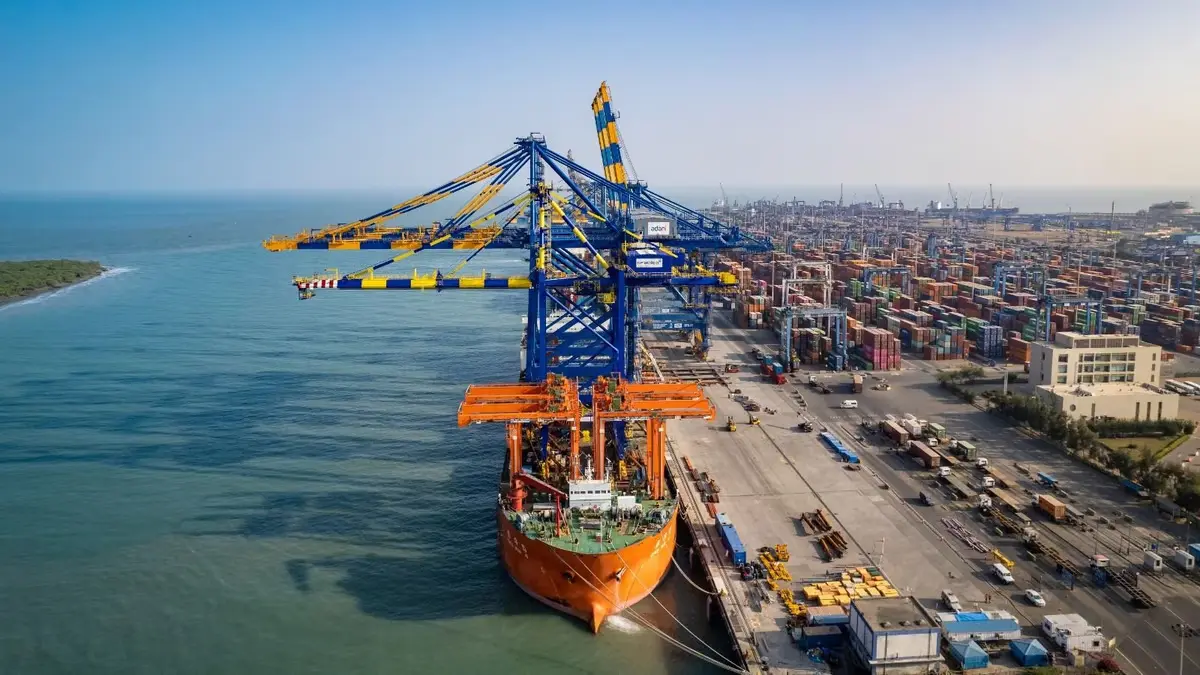
This is the opportunity behind port based value addition, and India’s new Vizhinjam International Seaport is particularly well positioned for it.
Located at the southern tip of India, Vizhinjam sits about 10 nautical miles from the main East-West shipping route connecting the Far East, Persian Gulf and Europe. It is India’s first deep-water container transshipment port, with a natural deep draft capable of handling some of the world’s largest container vessels.
For companies importing goods from Asia into the UAE and Europe, that location raises an important question:
Does every activity really need to be completed at the factory before the cargo begins its journey?
In many cases, the answer is no.
What is port based value addition?
Port based value addition means carrying out commercial activities on cargo at or around a port before the goods continue to their final destination.
Instead of using a port only for loading, unloading or transshipment, the importer uses the surrounding logistics ecosystem to make the cargo more valuable, more market-ready or more efficient to transport.
Port based value addition can include:
Packaging and repacking
Labelling and relabelling
Bulk-to-retail conversion
Kitting and bundling
Light assembly
Sorting and grading
Quality control and inspection
Palletization
Multi-supplier consolidation
Adding locally sourced components
Destination-specific product configuration
Managed warehousing
Inventory buffering before re-export
The model is closely related to value added logistics, port-centric logistics, cargo transformation, postponement logistics and late-stage customization.
The difference is largely one of supply-chain design.
Instead of asking, “Where was this product manufactured?”, importers start asking:
“Where is the most economical place to complete each stage of the product?”
That can produce a very different answer.
Why Vizhinjam changes the equation for global importers
Vizhinjam International Seaport is not located deep inside a manufacturing region that requires vessels to make a large diversion.
Its main advantage is geography.
The port sits close to one of the world’s major maritime corridors connecting Asian manufacturing centres with the Persian Gulf and Europe. Vizhinjam is approximately 10 nautical miles from this East-West shipping route.
This makes southern India a potential intermediate processing location for cargo moving on routes such as:
China → India → UAE
Vietnam → India → Saudi Arabia
Thailand → India → Europe
Southeast Asia → India → GCC
The concept becomes particularly interesting when Vizhinjam is already part of the container network serving the shipment.
Rather than viewing transshipment as an operational event that creates no additional value, importers can examine whether some containers should enter a value-addition workflow in India before being re-exported.
Vizhinjam is also scaling quickly as a transshipment hub. The port was commissioned in December 2024 with 1.6 million TEU of capacity. It handled 1.3 million TEU during FY26, crossed two million cumulative TEU within 18 months, and welcomed its 1,000th vessel in June 2026. Expansion is planned to increase capacity to 5.7 million TEU by December 2028.
For an importer, this matters because a viable port based value addition ecosystem requires more than low processing costs. It also requires mainline connectivity, container volumes, warehousing, handling infrastructure and reliable access to onward shipping.
The biggest opportunity is not cheap labour alone
It is tempting to reduce the argument for cargo value addition in India to labour cost.
That is too narrow.
The strongest opportunities often combine several savings at once.
Lower processing costs
Packaging, sorting, labelling, kitting, inspection and simple assembly can become expensive when performed in high-cost destination markets.
A UAE importer that receives bulk or semi-finished products and completes the work in Dubai may be paying destination-market warehouse and labour costs.
A European importer doing similar work after customs clearance may face an even larger cost difference.
Moving appropriate labour-intensive operations to India can reduce the cost per unit before the finished cargo reaches those markets.
And small per-unit savings add up quickly.
A saving of $0.05 across 40,000 units is $2,000 per container.
At $0.10 per unit, the saving becomes $4,000 per container.
The relevant question is therefore not whether India is a few cents cheaper for one operation. It is whether the total saving across an entire container exceeds the additional handling, storage and logistics costs created by the value-addition stage.
Calculate your potential savings with the CapeTerminal Cargo Savings Estimator
India sourcing can create a second layer of savings
Many importers purchase more from their overseas manufacturer than the actual core product.
A factory may also source the carton, bottle, label, insert, accessory, fastener or other component needed to turn the product into its final retail form.
The importer then pays the factory’s sourcing price, handling cost and commercial markup.
There is no rule that says all of those components must come from the same country as the main product.
With cargo value addition in India, an importer could source the core product from Southeast Asia while sourcing selected packaging or components from Indian manufacturers.
The final product is brought together before re-export.
For example:
Thai manufacturer → core product
Indian supplier → packaging
Indian supplier → printed materials
Vizhinjam region → packaging + QC + consolidation
Finished cargo → UAE
This creates what can be described as India sourcing arbitrage.
For some products, the saving from changing where packaging or components are purchased may be greater than the labour saving itself.
Ship the product efficiently, finish it later
Retail-ready products are not always freight-efficient products.
Final packaging can introduce cartons, bottles, trays, inserts, protective materials and empty space. Once that additional volume is created, the importer pays to transport it across thousands of kilometers.
For suitable commodities, it may be more efficient to transport the product in bulk or in a semi-finished configuration and add the final packaging later.
This is bulk-to-retail conversion.
Consider a hypothetical UAE importer sourcing a private-label household product from Asia.
The conventional model could be:
Factory → individual retail packaging → master cartons → container → UAE
An alternative model could be:
Factory → bulk product → Vizhinjam Port → retail packaging + Arabic labels + QC → UAE
If the bulk configuration allows substantially more saleable product to fit into the inbound container, the importer gains another potential source of savings: container utilization.
This opportunity is highly product-specific, but when retail packaging creates significant volume expansion, it deserves serious analysis.
Why UAE importers are particularly well positioned
The UAE combines high import dependence, large distribution networks, a strong private-label sector and access to markets across the wider GCC.
That makes it a natural market for port based value addition at Vizhinjam.
An importer does not necessarily need to change its manufacturer.
A company sourcing from China, Vietnam, Thailand, Malaysia or Indonesia could continue purchasing from the same supplier but change the point at which selected final activities take place.
The workflow might become:
Asian supplier → Vizhinjam International Seaport, India → warehousing → packaging / assembly / QC → re-export → UAE
This can be useful for importers handling consumer products, household goods, hardware, accessories, private-label products and other containerised cargo requiring repeatable processing.
Arabic labelling or destination-specific packaging could also be added later rather than requiring the manufacturing factory to maintain separate production runs for every market.
For a UAE distributor serving several GCC countries, that flexibility can become valuable in its own right.
European importers gain from postponement and late localisation
The European opportunity is not identical to the GCC opportunity.
Lower processing costs can still matter, but European importers may gain even more from postponement logistics and late-stage customisation.
Suppose a company imports the same core product for Germany, France, Spain and another European market.
The traditional approach may require the Asian factory to create separate packaging variants before the importer has precise information about demand in each country.
That creates fragmented inventory.
An alternative is to produce a common base product first and postpone selected market-specific activities until later.
Products can then be configured according to actual requirements before onward shipment.
Depending on the product, this could include:
Country-specific packaging
Instruction inserts
Bundling
Accessories
Labels
Retail cartons
Product kits
The importer delays the point at which one generic product becomes several different SKUs.
This is a well-established supply-chain principle known as postponement. Vizhinjam gives importers another geographic location from which to apply it.
Any EU product, packaging, labelling and regulatory requirements must be assessed before choosing such a workflow.
Combine suppliers from different countries
Another advantage appears when the final commercial product does not come from one supplier.
Global sourcing is increasingly fragmented.
A company may find that China is competitive for the core manufactured item, Vietnam is better for another component, and India offers attractive pricing for packaging or accessories.
Instead of forcing one factory to procure everything, the importer can separate the supply chain.
For example:
China → core product
Vietnam → accessory
India → packaging
Vizhinjam, India → consolidation + kitting + QC
Europe → finished commercial product
This is multi-country cargo consolidation combined with value addition.
It gives the importer more control over sourcing decisions and reduces dependency on a single OEM to manage the entire finished product.
The potential saving comes not from one cheaper activity, but from selecting the most competitive source for each part of the product.
Add an independent quality-control checkpoint
There is another reason to perform cargo transformation before the final destination: quality control.
Finding a problem after the goods reach Europe or the UAE can be expensive.
International freight has already been paid. Destination handling has started. Warehousing costs are accumulating. The inventory may already be committed to retailers or customers.
A controlled value-addition stage creates an opportunity to inspect the cargo before the final leg.
Depending on the product and agreed inspection scope, this could include:
Quantity verification
Packaging checks
Visual inspection
Photographic records
Sampling
Damage identification
Label verification
Checking completed assembly or packaging work
For importers working with several suppliers, independent cargo inspection also provides visibility into what is being shipped under their name.
The real challenge is managing the local workflow
Finding cheaper packaging or warehouse space in India is only part of the solution.
An overseas importer may need to coordinate a warehouse, packaging vendor, transporter, quality inspection team, customs broker, freight forwarder and several component suppliers.
Managing that network individually from Dubai, London or elsewhere can quickly become inefficient.
This is why managed warehousing matters.
CapeTerminal provides an operating layer between international importers and the network of facilities and service providers required around Vizhinjam.
Instead of treating storage as an isolated transaction, receiving, warehousing, inventory visibility, cargo value addition, QC and dispatch can be coordinated through one accountable workflow.
Explore CapeTerminal Managed Warehousing at Vizhinjam Port
For importers, the value is not simply access to a warehouse. It is having someone responsible for making the entire intermediate stage work.
Which products are best suited to cargo value addition at Vizhinjam Port?
There is no universal product category that should automatically be routed through India.
The strongest candidates usually share several characteristics.
They have high unit counts, meaningful packaging or assembly requirements, expensive destination-side processing, opportunities to source materials from India, or final configurations that can be postponed.
Potential use cases include private-label consumer goods, household products, hardware, accessories, home products, promotional merchandise, components, kits and other containerised goods with repeatable packaging or assembly workflows.
The model becomes especially interesting when a few cents of savings can be multiplied across tens of thousands of units.
When does port based value addition not make sense?
Adding another stage to a supply chain has a cost.
There will be shipments where direct factory-to-destination movement remains the better option.
Port based value addition may not be attractive when volumes are low, factory processing is already extremely competitive, handling risks are high, the product has difficult regulatory requirements, or additional dwell time outweighs the financial benefit.
This is why the decision should begin with numbers rather than assumptions.
Compare the current landed cost against the proposed Vizhinjam workflow, including:
Factory processing
Packaging and component costs
OEM markups
Freight
Port and container handling
Value-addition costs
Warehousing
Customs-related costs
Onward freight
Container utilisation
Inventory implications
The objective is not to send every container through an additional operation.
It is to identify the containers where Vizhinjam creates more value than the intermediate step costs.
Vizhinjam gives importers a new place to redesign the supply chain
India’s Vizhinjam International Seaport is usually discussed as a transshipment port.
For global importers, its larger opportunity may lie in what can happen around the port.
Its position beside the East-West shipping route places southern India between major Asian sourcing markets and important consumer markets in the Persian Gulf and Europe. Its growing mainline container activity gives that geography increasing practical relevance.
The opportunity is to stop thinking of the product as something that must leave the original factory completely finished.
The main product can come from one country. Packaging can come from India. Components can come from another supplier. Assembly can happen later. QC can take place before the final shipment. Market-specific configuration can be postponed until demand is clearer.
That is the broader case for port based value addition at Vizhinjam.
For UAE and European importers sourcing from Asia, India is no longer only another manufacturing origin.
Vizhinjam gives it the potential to become an intermediate cargo transformation, consolidation and value-addition hub within the global supply chain.
Frequently asked questions
What is port based value addition?
Port based value addition means carrying out activities such as packaging, labelling, assembly, kitting, inspection, sorting or consolidation at or near a port before the cargo continues to its final market. It allows an importer to separate the manufacturing location from the location where the product receives its final commercial configuration.
Where is Vizhinjam International Seaport?
Vizhinjam International Seaport is located near Thiruvananthapuram in Kerala at the southern tip of India. The port is approximately 10 nautical miles from the major East-West international shipping route connecting the Far East, Persian Gulf and Europe.
Why is Vizhinjam important for UAE importers?
Vizhinjam gives UAE importers sourcing from Asia another location to evaluate for packaging, assembly, consolidation, quality control and managed warehousing before cargo continues to the UAE. The financial benefit depends on cargo volume, processing requirements, freight, handling and the savings available from India.
Why could European importers use Vizhinjam?
European importers can use the concept to evaluate lower-cost value addition, Indian component sourcing, multi-country consolidation, quality control and late-stage product localisation before cargo reaches Europe.
Can imported cargo be processed in India and re-exported?
India has customs provisions for manufacturing and other operations on imported goods in appropriately licensed warehouses under Section 65 of the Customs Act and related regulations. The appropriate structure depends on the cargo and operation, so customs requirements should be confirmed before routing a shipment.
What cargo value-added services can be performed around a port?
Typical value-added logistics services include packaging, repacking, labelling, kitting, light assembly, sorting, quality inspection, palletisation, consolidation and warehousing. The suitable activities depend on the product, customs structure and destination-market requirements.
How can I determine whether Vizhinjam will save money on my shipment?
Compare the complete cost per container and per unit under your current supply chain with a Vizhinjam model. Include processing, packaging, materials, OEM markups, freight, handling, warehousing, onward shipping and any change in container utilisation.
Calculate the potential savings for your cargo with the CapeTerminal Cargo Savings Estimator